Sell the Outcome, Not the Seat
People have never wanted to buy software. It's always been a means to an end. The logical conclusion of that, taken seriously, is: just get the job done for me.
For decades, software was the best approximation of that. It made people faster, reduced errors, and lowered costs. But it still required someone to sit in the seat and use the tool. The customer bought the software, hired the person, and hoped the combination produced the outcome they actually wanted.
AI changes this equation. For the first time, a technology company can credibly deliver the whole outcome, not just the tool. And that raises a provocative question every SaaS leader should be asking: if I can now deliver the full scope of work, should I become a services business?
I want to be precise about what I'm describing, because there's an easy confusion. I know, because I've watched it happen in real time.
A few weeks ago, I raised this idea at a board meeting for one of our portfolio companies, a scaled SaaS business. I got a room full of confused stares. The immediate reaction was: "You mean we should hire more professional services people?" No. That's not what I mean. And the fact that this was the instinctive interpretation tells you how deeply the SaaS mental model is embedded.
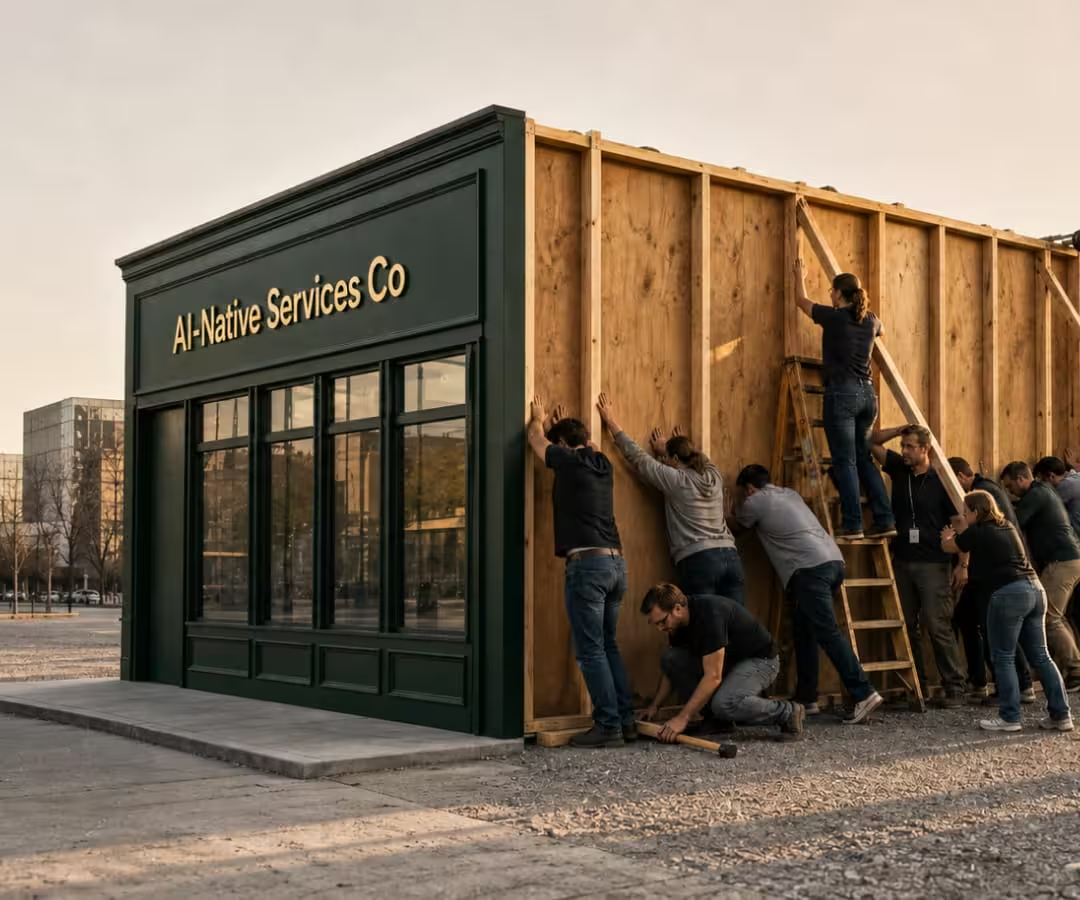
What I'm describing is becoming an AI-Native Services company. The end customer may never touch your software. They just get the outcome. The software is yours. The AI is yours. The responsibility for delivering the result is entirely yours.
To their credit, that same company has spent the weeks since that meeting deeply exploring the idea. They've partnered with a services business in their space and are actively evaluating a pivot to AI-native services. The confused stares turned into genuine curiosity once the logic clicked.
%20(1).png)
Three Reasons to Make the Leap
1. Your buyer is disappearing
Here's the uncomfortable reality many SaaS companies are facing: the people you sell to are getting laid off.
Block recently cut a significant portion of its workforce. So have dozens of other companies across tech and beyond. As AI makes individual workers more productive, companies will need fewer of them. The person who used to buy your software, log in every day, and champion your renewal may not be in their seat in two years.
Corporate layoffs are, paradoxically, a tailwind for AI-native services. Companies that cut headcount for the stock bump often don't have the AI infrastructure in place to absorb the lost capacity. That work still needs to get done. Outsourcing to an AI-native services company that guarantees the outcome becomes more attractive than rehiring, especially when the vendor can do it faster, cheaper, and with more consistent quality.
For SaaS businesses, this same dynamic is a headwind. Fewer seats means fewer licenses, lower NRR, and a shrinking addressable market. The same macro trend that threatens your revenue model could fuel a services model built on the same underlying product and addressing a much larger TAM.
.png)
2. It's the best defense against "won't Claude just do this?"
Every software company is now being asked some version of “Anthropic- friend or foe?” And for many, the honest answer is uncomfortable.
Foundation models are getting better at an extraordinary rate. Features that took engineering teams months to build can now be approximated by a well-prompted Claude or GPT in minutes. If your product is primarily a UI on top of reasoning, you are in the blast radius.
But foundation models don't guarantee outcomes. Claude can draft a contract, but it won't take responsibility if the contract has an error that costs you a deal. It can analyze financial data, but it won't guarantee the accuracy of the accounting to your auditor. It can write marketing copy, but it won't own the campaign performance.
AI-native services companies do. By taking full responsibility for the outcome, you occupy a position that foundation models are structurally unlikely to pursue. Anthropic, OpenAI, and Google are building general-purpose reasoning engines. They are not going to become your outsourced accounting department or your managed legal team. The liability, the domain specificity, the customer relationship, the quality assurance layer: that's your value add on top of the models.
This is the difference between selling a tool that competes with foundation models and selling a result that sits on top of them. The tool is exposed. The result is defensible.
3. It’s ROI or Die
It’s often hard to establish causality between SaaS and business outcomes. In this era, ROI is on every CFO’s mind more than ever. AINS provides a path away from constantly having to justify your existence.
What Changes When You Make the Switch
We've been working with a variety of founders who have made this transition. Here's what they've learned, and what you should expect.
Your competitive set gets dramatically easier. As a SaaS company, you're competing against best-in-class tech companies for buyer attention. You're in RFPs with well-funded startups and entrenched incumbents who have been building products for a decade. As a services company, you're competing against service providers who are slower, more expensive, and less tech-savvy (though many are now claiming to have added AI). The competitive landscape changes in your favor.
Outcome-based pricing forces you to get good, fast. When every dollar of revenue is tied to a success fee, you can't afford inefficiency. That sounds terrifying, but founders tell us it's liberating. It forces you to automate everything that can be automated and focus your human effort where it matters most. Incumbent service providers have been passing inefficiencies along to clients for years. You can't, and that constraint becomes your advantage.
You finally get the data you always wanted. When you're selling software, your feedback signal is whether customers continue to pay. You can't see the actual outcomes. Once you're delivering the work yourself, every engagement generates data that improves the next one. Your reinforcement loop shifts from "are they renewing?" to "did this specific piece of work produce the right result?"
One founder told us this was the single biggest unlock of the transition: "I was embarrassed about my product when I first used it as a customer." That embarrassment is a gift. When you become the primary user of your own software, you feel every workflow gap, every broken integration, every clunky UX choice. From there, product development velocity increases because the feedback loop shrinks from quarterly NPS surveys to daily lived experience.
Your entire go-to-market posture has to change. You're no longer selling to a technical buyer who expects a startup pitch. You're selling to an operations leader who expects a trusted service provider. Present yourself as someone customers trust with their outcomes.
Hire a well-respected practitioner from the industry that’s also AI-pilled. A good interview filter: ask candidates to explain what they've already built with AI tools. If the answer is nothing, they're not a fit.
The Valid Objections
I don't want to pretend this is easy. There are real barriers to making this work.
It's a DNA transplant. Building and selling software is a completely different muscle from delivering outcomes. You're moving toward something that looks more like a professional services firm than a product company. That's not what your team was hired to do. The org design changes are drastic: you may need domain experts you've never had, delivery infrastructure you've never built, and a sales motion your team doesn't know how to run. You likely need to make some hard decisions to part with teammates whose skillsets/mindsets aren’t aligned with the new direction.
Making the SaaS to AINS shift is often harder the bigger the existing business. It can be extremely difficult to let go of a business you spent years building to scale.
You still have a book of business. All those existing customers have product roadmap demands. Do you keep building for them while standing up an entirely new delivery model? This is a classic innovator's dilemma: the existing business is generating revenue today, and the new model is unproven. It takes real courage to start shifting resources.
Gross margins are the existential question. If you can't do the delivery work primarily through AI, you've just converted a high-margin SaaS business into a low-margin services business. That's a downgrade, full stop. The entire thesis depends on AI doing the lion's share of the work, with humans handling exceptions, quality assurance, and customer relationships. Your gross margin trajectory is the single most important metric in this transition. Makes sure you calculate it correctly by including the salaries of the people doing the service as well as inference spend. If it's not improving quarter over quarter, you're building a staffing company, not an AI-native one.
Defensibility requires intentional work. Services businesses are inherently more fungible than software platforms. Switching a BPO is easier than ripping out an integrated system. You need to think deliberately about what makes you sticky. A few avenues:
- Proprietary data assets that accumulate over time. This is not just for fine-tuning, but also as a valuable archive of work products that customers want to reference and can only access through you.
- A leave-behind software product, like Palantir Foundry, that gives customers a foothold to keep working with your data after an engagement ends.
- Deep integration into the customer's systems of record, so that pulling you out would be disruptive.
- And brand, which matters more in services than in software: you're asking customers for trust, and a track record of demonstrated success compounds into real defensibility over time.
We go deeper on each of these defensibility strategies in our AI-Native Services Playbook.
Does This Apply to You?
Not every SaaS company should make this transition. It makes the most sense when five things are true.
1. Your buyer persona is under threat. The people who use your software, the ones who champion your renewal, log in every day, and fight for your budget line, are being consolidated, automated, or laid off. If the headcount in your buyer's department is shrinking, your addressable market is shrinking with it. This is the most urgent trigger. It means the transition isn't just a strategic option; it may be a necessity.
2. The function you serve is critical but non-core for your customer. They need the work done, but it's not what differentiates them. They'd happily hand it off to someone they trust. Fund administration, insurance brokerage, compliance reporting, revenue cycle management: these are all essential functions that companies would rather not do themselves. If your customer views the work as core to their identity and competitive advantage, they're less likely to want an outside provider owning the outcome.
3. Meaningful spend already flows to service firms in your category. If your customers are already outsourcing this work to consultants, agencies, or BPOs, the buying motion for an outcome already exists. You're not creating a new budget line; you're redirecting an existing one. This also means there are incumbents to study: you can learn their pricing, delivery model, and weaknesses before you enter the market.
4. The work is repetitive enough for AI to do the lion's share. This is the gross margin question, and it's existential. The entire thesis depends on AI handling most of the delivery, with humans managing exceptions, quality assurance, and customer relationships. If the work your software supports is highly bespoke and judgment-intensive, the AINS model is much harder, because you end up with a low-margin services business rather than an AI-leveraged one. The diagnostic is simple: is the work high-volume and standardized, or low-volume and unique every time? The more repetitive, the better your margins will be.
5. You genuinely believe your product produces better outcomes than the alternatives. This is the one that requires real honesty. Committing to deliver outcomes forces an uncomfortable question most SaaS companies avoid: does our product actually move the needle? If you've been selling a tool and hoping customers figure out how to get value from it, now you're on the hook for that value directly. If the answer is "our product isn't good enough to stake our reputation on," that's a harder conversation, but it's one worth having before the market has it for you.
Why Waiting Is the Bigger Risk
I understand why this feels terrifying. You've built a scaled SaaS business. You have ARR, net retention, gross margins that investors love. The idea of walking away from that to dive into something unproven feels reckless.
But consider the alternative. Foundation models are improving on a curve that will not slow down. Every quarter, more of your product's functionality becomes replicable by a general-purpose AI tool. Your buyer persona is under pressure from automation. Your competitive moat is narrowing.
The worst version of this story is the one where you wait two years, watch your NRR decline from 120% to 95%, see your best customers start experimenting with AI agents that replace what your software does, and then try to make this transition from a position of weakness rather than strength. The pivot is hard enough when business is good. It's exponentially harder when you're already shrinking.
Making a big bet to adapt is less risky than deluding yourself into thinking the relative status quo is safe. The SaaS companies that will thrive in five years are the ones making hard decisions now, not the ones optimizing for one more year of comfortable metrics.
An Invitation
If you're a SaaS leader thinking about this, or a founder building an AI-native services company from day one, I'd love to hear from you. We've published a detailed AI-Native Services Playbook that covers the mechanics: how to build the team, how to structure pricing, how to think about defensibility, and how to measure what matters.
The playbook for this new model is being updated in real time. If you want to follow along, subscribe here or find us on LinkedIn.