A version of this article originally appeared on Fortune.com
The rules of the AI economy are being set right now, and no one is setting them on purpose. We’ve seen this happen before. Between 1920 and 1927, American broadcasters staked out radio frequencies faster than the law could follow. Herbert Hoover, then Commerce Secretary, held four national radio conferences to broker voluntary rules of cooperation among broadcasters. At the same time, he told Congress that those voluntary rules wouldn't be enough. The public interest principle that he believed should govern the airwaves needed a real law behind it, or it had no teeth.
By the time Congress acted with the Radio Act of 1927, the ownership structure had already hardened. The Communications Act of 1934 mostly ratified it. The window between a new technology's arrival and the hardening of its power was much shorter than anyone expected.
We are in a similar window with AI, and far more is at stake. Radio was a bureaucratic battle over who owned the airwaves. The resource this time is human intelligence: how people reason, decide, and create. If we treat that as something to extract rather than cultivate, we drain the source that every future breakthrough depends on.
Every organization building an AI system on top of its employees' work is making an implicit claim about who owns what that system learns. Every platform that captures the judgment behind a decision, the correction that improved a result, the reasoning that closed a deal, is accumulating something that used to walk out the door with an individual. In June, we argued that the AI doomers are counting jobs when they should be counting traces: the corrections, judgment calls, and workarounds people leave behind on every system they touch. So who owns them? No one has decided yet.
None of this is malicious. But if the rules aren't shaped intentionally, the companies controlling the most powerful models will set the terms, and everyone else will pay rent.
Before these norms harden, we're proposing a starting place: a social framework for consideration and conversation. In the coming months, we'll bring founders, researchers, legal scholars, and labor voices together to stress-test it.
What follows is a first attempt, not the final answer.
Why a social framework
There is precedent for this working. The Internet Engineering Task Force built much of the architecture of the modern Internet through open standards adopted without government mandate.
There is also a cautionary precedent. The W3C's "Do Not Track" privacy standard won broad browser adoption and regulatory support, and collapsed anyway, because companies faced no real cost for ignoring it. Princeton researcher Arvind Narayanan, who participated in the process, later argued that once the threat of legislation faded, the effort mostly gave the appearance of self-regulation without substance.
The three layers
The intelligence economy needs a social contract with three layers: platform, organization, and individual.
1. At the platform level: choice
No single model should become the unavoidable infrastructure of intelligence.
The durable advantage in the intelligence economy sits above the model, not inside it, and that becomes more true as foundation model capabilities converge. What matters is the learning loop an organization builds on top of whichever model it runs: the domain-specific training, the institutional memory, the orchestration that a competitor cannot replicate by switching providers. That advantage only exists if the market rewards cultivating better judgment over time.
The status quo is the opposite. The provider's incentive is to make switching expensive, which means organizations are often locked into whichever model they adopted first.
But access to AI capability should not require surrendering intelligence as a condition of service. Organizations should be able to choose which models they build on, port their workflows when they leave, and decline participation in model training without losing access to what they're paying for.
2. At the organization level: sovereignty
The learning loops, workflows, and domain expertise organizations build on top of AI belong to them. The fine-tuning that turns a generic model into something that reflects how a particular organization operates is an asset, and it deserves deliberate protection.
But protecting something requires being able to name it. Expert-network firms like GLG, AlphaSights, Third Bridge, and Guidepoint have spent decades converging on a definition: proprietary information is information that belongs to an organization rather than to the individual who happens to know it, that isn't publicly available, and that has competitive or economic value specifically because it's kept secret. The AI economy needs this same distinction, especially now that human expertise is being harvested as training data.
That harvesting is already underway. Cognitive Task Analysis (CTA) has interviewers walk professionals through complex, real-world problems step by step, capturing not only their decisions but why they chose one strategy over the alternatives. RedCompass Labs uses it to build its Payments Expert Agent, turning thousands of hours of expert work into datasets that teach AI how specialists reason. Done carelessly, it can pull an employer’s proprietary methods out through an individual’s reasoning, which is the line defined above.
When employees use public AI tools to do their work, they teach those tools how the organization operates. A long session with an external agent encodes decision logic, process sequencing, and priorities, some of the most valuable things a model can learn. Enterprise contracts usually prohibit training on internal data, but the protection around behavioral traces and process knowledge is far less settled.
Not every workflow deserves the same protection. Routine, standard operations are one thing. But the outliers are another: the rep who ignores the standard script and closes the deal anyway, or the engineer's fix that isn't in any runbook. Those moments are the actual source of improvement. It’s the generative part of the loop. Protection should follow along the lines of that distinction: default transparency for the routine work, real sovereignty claims reserved for the judgment that changed the outcome.
3. At the individual level: appreciation
Appreciation here carries two key meanings. The first is recognizing that a person brings their unique lived experience and judgment that no model can generate on its own. The second is about how a person's judgment should be worth more when they leave a job than when they arrived. Models get smarter by learning from human judgment. Do humans get smarter, too? Does using these systems make someone sharper or duller? What does each side keep when the relationship ends?
This is the individual layer, the least settled of the three, and the one place the framework reaches past ownership into design.
Whether AI appreciates human intelligence or only harvests it depends on how it’s designed, and on whether growing that intelligence is the goal. That growth compounds for the organization, and it travels with the person.
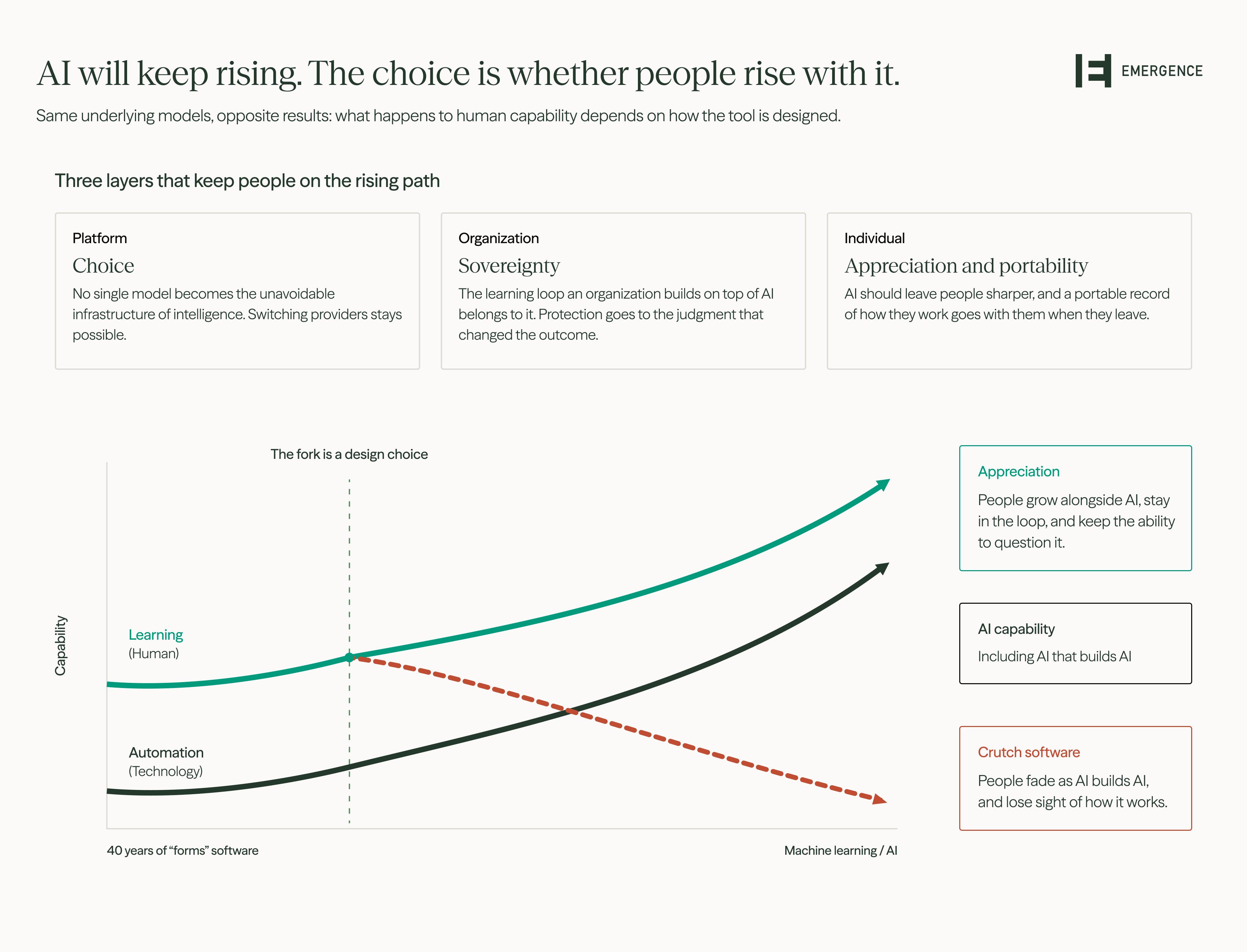
We have long talked about “Crutch Software”: systems that do the work but don’t help improve the people using them. Most enterprise AI today is crutch software at scale. It hands over an answer without asking the user to judge whether that answer is right, or how it could be better.
A 2025 randomized controlled trial shows the cost. Undergraduates who used ChatGPT as a study aid scored significantly lower on a surprise retention test 45 days later than students who studied the traditional way. The tool made answers easy to get and took away the recall that makes learning stick. The author’s term for it: “a cognitive crutch.”
Anthropic’s own researchers found a similar pattern in a small randomized trial of 52 developers learning a new coding library. Those who used AI scored 17% lower on a quiz than those who coded by hand, with the biggest gap in debugging. How they used it mattered. Developers who asked AI to explain, or posed conceptual questions, kept their understanding, while those who delegated the work did not.
But a crutch is a design choice. A Harvard randomized controlled trial tested an AI tutor built the opposite way: it asked questions and withheld answers until students reasoned their way to them. Students using it gained more on tests right after the lessons than peers in a well-run active-learning classroom, in less time. The study doesn’t establish long-term retention, but it shows how AI can be designed to support learning.
We believe the technology people use should make them better at their work. This is the next layer of our Coaching Networks thesis. The early generations watched the best performers and spread their moves to everyone else. The next generation builds human capacity to invent new moves, which means designing friction back into the system. Without the friction of understanding and internalizing new concepts, workers will atrophy as AI ascends.
People should also leave their roles with more than they brought in. When a doctor leaves a hospital, he takes his clinical judgment; the hospital keeps the patient records and the protocols. Trade secret law draws the same line between an employer's protectable secrets and an employee's general skill. AI blurs it by capturing both a person's output and the approach behind it.
A “cognitive passport” could restore the line. Think of it as a portable, anonymized record of how a person approaches problems, with the deals, documents, and confidential processes excluded. The organization keeps what it learned. The person keeps the ability to apply their judgment elsewhere. That portability gives people a reason to keep growing and contributing, and companies that support it will recruit against companies that don't.
Consider an enterprise sales rep moving on after four years. Her company’s AI watched thousands of her calls and every deal she closed, and it now coaches the rest of the team using her moves. When she leaves, the calls, records, customers, pricing, and the coaching model itself stay with the business. Her passport records her patterns: she opens with a question about the buyer’s last quarter, slows down when a CFO joins, drops the script with technical buyers, and notes the moments she overrode the system and was right. That habit is hers. The company’s discount floor is not. The system that holds the data generates the passport, the employer clears it against a confidentiality review, and her next employer judges it like a portfolio. What doesn’t exist yet is a common format that would make a passport from one company mean something at the next.
Why Emergence
Humans craft and compound: we absorb new information, change, and build on each other’s ideas. Multiply that by 8 billion people and you get what we most underestimate about human uniqueness. That is why humans are the only mutation engine in the age of AI. AI can master any game with fixed rules. Markets keep changing the rules, and people are the first to see the new game. The job of a well-designed AI system is to find those breakthroughs and spread them. The risk is people collapsing into generic thought, or leaving the thinking to AI.
The temptation now is to use AI to reduce human work. We think that's the wrong target. The goal is to make human thinking more powerful, more durable, and more portable. People will keep working. The question is whether the intelligence they generate compounds in their favor or flows to a platform they don't control.
It is early enough that the answer is still a choice. McKinsey’s 2026 survey found that 89% of organizations use AI in at least one business function, but only 44% report scaling it across the enterprise, up from 38% a year ago. That is exactly the window where a genuine-choice principle does the most good.
We are not a policy shop, a law firm, a standards body, or a regulator. We are a venture firm that has backed enterprise software companies since 2003, and we are arguably the wrong institution to write this framework alone. We are also not a disinterested party: we make money when the companies we back get more valuable, and we won't pretend the practical and the principled are perfectly separable here. We believe in a free market for intelligence. Open and closed models can coexist, and the strongest ecosystem probably needs both. But it cannot afford captivity.
More than twenty years in this industry have shown us that technology creates the most durable value when more people participate. Open standards made the internet market bigger for everyone. The intelligence economy will create more value if the people whose thinking feeds it have a reason to trust the system they're building. That is a good bet, and one we'd like to make.
A future where cognitive labor is extracted without acknowledgment, where the people who trained the systems are treated as raw material rather than co-authors, is a glum one.
An opening, not a conclusion
Nobody knows yet where the lines should sit. Not the companies building these systems, not the regulators, not us. But the moment to decide is not after the architecture is built. It is now, while it is still being designed.
The convenings start soon, and we will share what we hear. We expect to be wrong about parts of this framework. Do Not Track died because ignoring it was free. What does ignoring this framework cost, and who imposes it?
If you have a reaction, we want it.