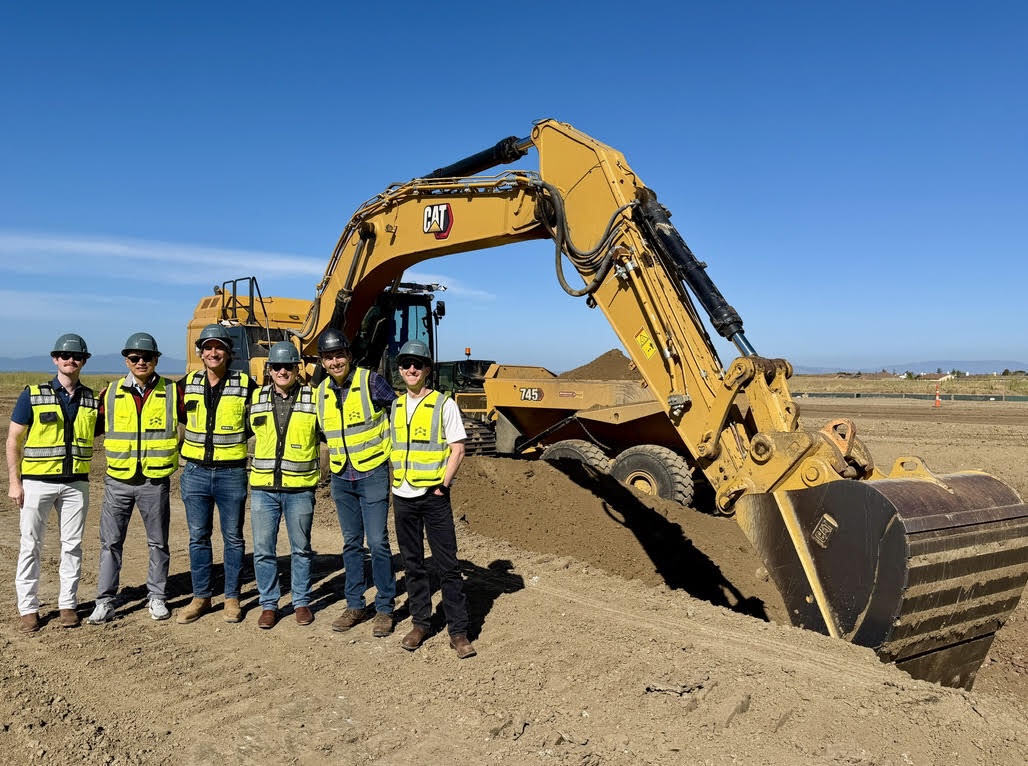
This August, on a water treatment site in Nevada, an excavator dug to grade and loaded dump trucks for a full shift with nobody in the cab.
Not a demo lot. Not a fenced-off test. It was the first time an excavator had done real commercial work entirely on its own. Since then, Bedrock has scaled rapidly, providing autonomous excavation services building data centers, manufacturing facilities, and more across the country.
Today we're doubling down. Emergence is co-leading Bedrock's $600 million Series C alongside CapitalG. When we first backed Bedrock in 2025, we bet that autonomy could change the economics of heavy construction. In February we wrote that once autonomy delivers throughput, safety, and schedule certainty at the same time, it stops being experimental. This summer it stopped being experimental. This round is about what comes next.
Why construction can't wait
Industries representing more than 20% of global GDP face critical skilled labor shortages, and construction is exhibit A. Demand for housing, factories, data centers, and infrastructure keeps climbing while the workforce to build them shrinks, and productivity has been flat for decades.
The operator seat is where it bites hardest. The U.S. needs to fill roughly 46,000 construction equipment operator jobs every year through 2034, most of them replacing people who retire, and it takes about five years to train a competent replacement. Nearly nine in ten contractors have open craft positions right now, and worker shortages are the single biggest reason projects run late. The industry doesn't have five years.
In February we argued that construction needs a new operating model, not better software. Bedrock's answer is autonomy that reasons about the work, on the machines contractors already own.
Proven, not promised
Bedrock started with the hardest machine on the site. An excavator is an articulated hydraulic beast that has to read the soil, the trucks, and the people around it and decide what to do next. Solve that first and the dozer, the loader, and the haul truck arrive later as easier versions of a problem already beaten. The team's lineage shows: Boris Sofman, Kevin Peterson, and much of the engineering bench came from Waymo, where they helped build the systems that put driverless cars on public roads, and from Caterpillar.
While the founding team had unparalleled domain expertise in autonomy and construction, they, nor anyone else, had ever priced an autonomous excavator. This is the definition of an emerging business model, exactly where Emergence loves to partner.
Across a series of working sessions, we pressure-tested pricing and packaging against what we'd watched contractors actually pay for: utilization, throughput, safety, and schedule certainty. The result is a model built around the economics of the job site rather than the robot. And because Bedrock retrofits the fleet a contractor already runs, adoption doesn't start with a capital purchase. This model is now translating into rapid commercial traction.
Construction has spent decades trying to squeeze more out of the same two constraints: people and machines. Bedrock changes the math on both. Autonomy that runs on the fleet contractors already own doesn't just make a job site more productive. It changes what the industry can afford to build.
Jake Saper, General Partner
Why we're doubling down
In 2015 we led DroneDeploy's Series A and spent the better part of a decade alongside that team, learning what it takes to get robotics into contractor workflows and build a commercial model around how contractors actually operate. This July, Procore acquired DroneDeploy for $845 million. Those lessons shaped how we underwrote Bedrock, and they're why we moved to double down to co-lead the Series C.
We’ve worked closely with the leaders in construction robotics since 2015, and the pattern is consistent. The hardware was never the hard part. The company that wins is the one that fits the machine into the customer's existing workflow and owns the deployment data. Bedrock chose to be a neutral autonomy layer across fleets contractors already run, instead of asking them to buy new iron.
Kevin Spain, General Partner
One autonomous excavator is a productivity story. A coordinated fleet of excavators and haul trucks working alongside a human crew is a different way to plan a project, staff it, and decide what gets built at all. Dump trucks, dozers, and loaders are next on Bedrock's roadmap, and the Series C is the capital to get there. We said in February that Bedrock could become the default autonomy platform for heavy construction. Eight months of deployments later, we’re millions of cubic tons of dirt moved closer to that goal.
Congratulations, Boris, Kevin, Laurent and the whole Bedrock team. We're thrilled to deepen our partnership.
Read why we first backed Bedrock here, and Kevin’s piece on why assemblers win in robotics.