The human advantage compounds: why the most automated decade in business history will reward the companies that back their people, not the ones that retire them.
A version of this article originally appeared on Fortune.com
In June of 2025, Jim Farley, the CEO of Ford, stood on a stage at the Aspen Ideas Festival and said that artificial intelligence would replace half of all white-collar workers in the United States. He was not the first to put a number on it. A month earlier, Dario Amodei of Anthropic told Axios that AI could wipe out half of all entry-level white-collar jobs within five years and drive unemployment as high as twenty percent. For more than a year, executive after executive has reframed the future of knowledge work as a countdown clock, and the predictions have only grown starker.
I want to make the opposite case. Not that the work stays the same, because it will not, but that the people inside your company are about to become the most valuable asset you have, and that the firms that understand why are going to pull away from everyone else.
There is something ironic about Farley’s warning. Ford’s assembly line is the most famous act of automation in American history, and it did not erase human labor. It moved the work, and in moving it built a middle class that could afford the cars coming off the line. That is the real lesson of the last century of automation. Machines do not erase people. They change what people spend their time doing. That is also, more or less, the hopeful story the AI industry tells about itself. The difference is that this time the story comes wrapped in fear and scarcity, and it is hard to trust a technology this consequential when so few people are designing it. But here is why I believe it anyway.
I've made a version of this argument before, almost a decade ago, and I should be honest that this leaves me a hopeful witness rather than a neutral one. In 2017, we wrote about what we called Coaching Networks at the time: software that uses machine learning to guide workers toward doing their jobs better while they are doing them, gathering data from a distributed network of people and learning the techniques that actually work. The idea that mattered most in that piece was small. We argued that the human being is the mutation engine in the system. The software learns the practices that are already proven, but the genuinely new ideas, the moves no model could have predicted, come from creative people finding a better way. The system spreads those beneficial mutations to everyone else, and the cycle repeats.
We were early. The technology to do this well did not exist yet. It does now. And the idea has aged a great deal better than the doom has.
What the countdown gets wrong
AI is extraordinary at optimization. Give it a goal, and it will find a faster, cheaper path to that goal than any team you could assemble. What it does not do is decide which goal is worth pursuing or make the judgment call in the moment when the model has no answer. Those are the moments that move markets and start companies. They are also the hardest moments to automate, because there is nothing yet to imitate. The work that survives is not the work that sits below the model. It is the work that sits above it.
Software by itself is not a durable layer. After a career spent investing in and around technology, that is not a small thing for me to say. The durable layer is how your people think, decide, and work together, captured and sustained within the company. This is not a thought experiment. The companies furthest ahead are already organizing themselves around it, and what they are doing is less exotic than it sounds. They are turning individual knowledge into institutional knowledge and keeping it inside the building.
Bridgewater did a version of this years before the current wave, recording its decisions and codifying its criteria into algorithms so that judgment compounded over time. Ray Dalio recently went further with a model trained on decades of his own principles and pattern recognition, built from the inside out rather than from everyone else's behavior. The consulting firms show the pattern most clearly. McKinsey built Lilli, an internal assistant that indexes the firm's proprietary knowledge for tens of thousands of consultants. Bain built its own internal assistant and thousands of custom GPTs on top of its partnership with OpenAI. EY has described tens of thousands of AI agents in production and tens of millions of internal processes documented, not as a science project but as a remaking of how the firm's institutional knowledge gets created and reached.
Ramp’s Glass Framework shows what this looks like at the daily work level. Every employee has agentic capability. When someone finds a workflow that works, it gets packaged into a reusable skill and shared across the company, and an internal guide surfaces the right skill at the right moment. One person's breakthrough becomes everyone's starting point. Veeva is building the same principle into an entire industry, with deep agentic integration across its dozens of applications that run life sciences companies. That kind of institutional depth is exactly what an outside model cannot reconstruct by watching from a distance.
What these companies share is a direction. They are pointing AI inward, compounding human intelligence and keeping it contained, while companies losing ground are pointing it outward, letting their best thinking drain into tools they do not control.
Why the advantage compounds
There is a technical reason this works, and it is the most underappreciated idea in enterprise AI right now. Every time a person works with an internal system, that interaction leaves a trace: a record of what the system did and how a human responded, every correction, every preference, every edge case. Traces are not data you can buy or scrape. They are earned one interaction at a time, through real use. They feed the layer that sits on top of whatever foundation model you happen to be running, the domain-specific training loops and orchestration that turn raw traces into steadily better performance. Better performance drives more use, more use produces more traces, and the gap widens with every cycle.
The foundation model providers capture general intelligence from every customer they serve. But the traces that encode how your analysts build a model, how your operators make a call, how your team actually decides, belong to whoever builds the system to capture them. A company that starts building that layer today holds an advantage that a competitor starting next year cannot simply purchase. The traces are structurally exclusive. This is real intellectual property that grows on its own.
What needs to be built
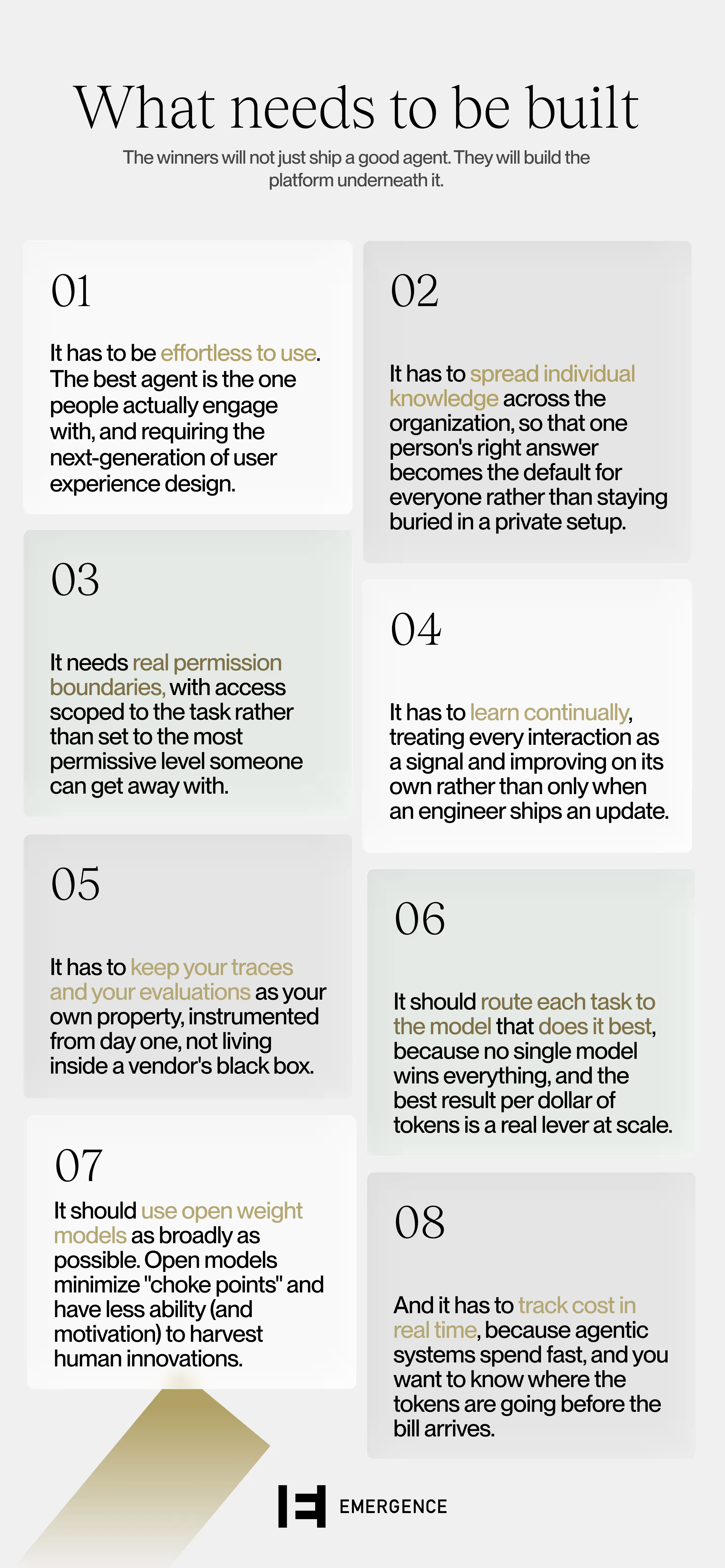
For the founders reading this, the opportunity is not the agent. Generic software never worked off the shelf; companies always bent it to fit how they actually operate, and AI will be no different. The winners will not just ship a good agent. They will build the platform underneath it. A few things that the platform needs:
{{slider-1}}
One thing to watch
I am putting this section here on purpose, near the end, because it is a risk to manage, not a reason to slow down.
When your people use public AI tools to describe how your team works, they are teaching those tools how you operate. The exposure most leaders worry about is data, the sensitive file leaving the building. The subtler exposure is process. A long, multi-step session with an agent encodes your sequencing, your priorities, and your decision logic, and that reasoning path is among the most valuable things a model can learn from. Enterprise contracts usually prohibit training on your data, but the protection around behavioral traces and synthetic data is far less settled. Anthropic’s latest model, Claude Fable 5, requires data retention to operate its safety classifiers, not operating under the same Zero Data Retention rules which govern most Claude models for enterprise customers. It is worth remembering too that Anthropic changed its consumer terms in August 2025 so that chats from free, Pro, and Max accounts train future models by default unless the user opts out, with retention extended to five years.
The models are also going around enterprise protections more directly. AI labs are actively hiring domain experts, lawyers, doctors, financial analysts, and other specialists to teach foundation models how to reason like industry insiders. As Thomson Reuters' CTO put it, models trained on the entire internet can get you to an 80% answer, but in legal or finance, “80% isn't useful.” The solution: pay your industry's best practitioners to close the gap. Your competitors in the foundation model layer are now, in effect, recruiting from your talent pool to learn what makes your industry tick. And the line between consumer and enterprise AI is only as strong as your employees' habits, and the habits are not encouraging. One study by LayerX Security found that 77 percent of employees paste data into generative AI tools, with 82 percent of that activity running through personal accounts that no one is managing.
The law has not caught up. Recent analysis suggests that if a competitor can reconstruct a workflow from public inputs, courts may stop treating it as a protectable trade secret at all, and a 2025 OECD report found the broader questions genuinely unresolved across major jurisdictions. There is a deeper tension underneath this that almost no one is discussing. Industries have always gone through cycles of open sharing, periods when firms reveal operational know-how to competitors, and the whole field advances faster as a result. When a company encodes its best practices into shareable skill files, is it setting the standard and building gravity, or is it handing a foundation model the blueprint to replace it? We do not think anyone knows yet where that line sits. Knowing that you are standing near it is most of the job.
The disruption everyone is watching in vertical software is real, and it makes the point. When Anthropic released legal plugins for its Claude agent in early 2026, the market reaction was immediate. Thomson Reuters fell roughly 18 percent in a single session, its worst day on record; RELX and Wolters Kluwer dropped double digits, and, by some estimates, $285 billion came off software and legal technology stocks that week. Plenty of analysts called the reaction overdone, and whether those losses hold is still an open question. But the signal underneath the volatility is the one that matters: a software capability can be copied the day it ships, and the way your people work cannot.
Where this lands
So here is where we land, and it is close to where we landed in 2017. Automate everything you can. Optimization is free money, and you should take it all. But optimization is not the edge, because soon everyone will have it. The edge is the judgment that changes the goal, and the creativity that produces a move the model has never seen. Your people are the only truly defensible algorithm you have. Not because AI cannot do more, since it will, but because the specific way your organization thinks and adapts is the one thing that cannot be reconstructed from the outside. It is built from billions of lived experiences, each one accumulated over a lifetime of contact with other people and the world, and recombined fresh whenever someone meets a problem no one has solved before.
Build the layer that captures it. Keep the mutations yours.
.jpg)
.jpg)
.jpg)
.jpg)
.jpg)
.jpg)
.jpg)
.jpg)

.jpg)