AI made your teams faster. Now, design the org to match.
Most startups are adopting AI faster than they're redesigning the company around it. The tools are working, but that's not the problem. I spend my days helping the best technical founders in the Bay Area build their teams, and the constraint I keep running into isn't talent. It's architecture.
The limitation is no longer writing code or feature deployment. Instead, it's directing the work, distributing context, making decisions, and creating feedback loops that allow AI and humans to operate together effectively. The shift isn't subtle, and the founders who treat company design as the job and not an afterthought, are going to outbuild competitors twice their size.
Talented people aren't the differentiator anymore. Everyone's hiring from the same pool. What matters now is clear direction, fast work distribution, shared context, tight feedback loops. The company itself has to be designed, not just staffed.
Across our portfolio, engineers are shipping at a pace that wasn't possible 18 months ago. The hard part of building software has changed. It's no longer writing the code; it's verifying it's correct. When code is easier to produce, the real work becomes reviewing and trusting it. Agentic loops are handling tasks that used to require people: reviewing PRs, planning sprints, reworking large parts of a codebase.
But we're also starting to see where org design comes up short. The most common pattern is a coordination failure. A decision stalls because the context behind it lives in someone's head, not somewhere an agent or a teammate can find it. The baton gets dropped because the system wasn't designed to pass it cleanly. That friction compounds fast when everyone is moving faster.
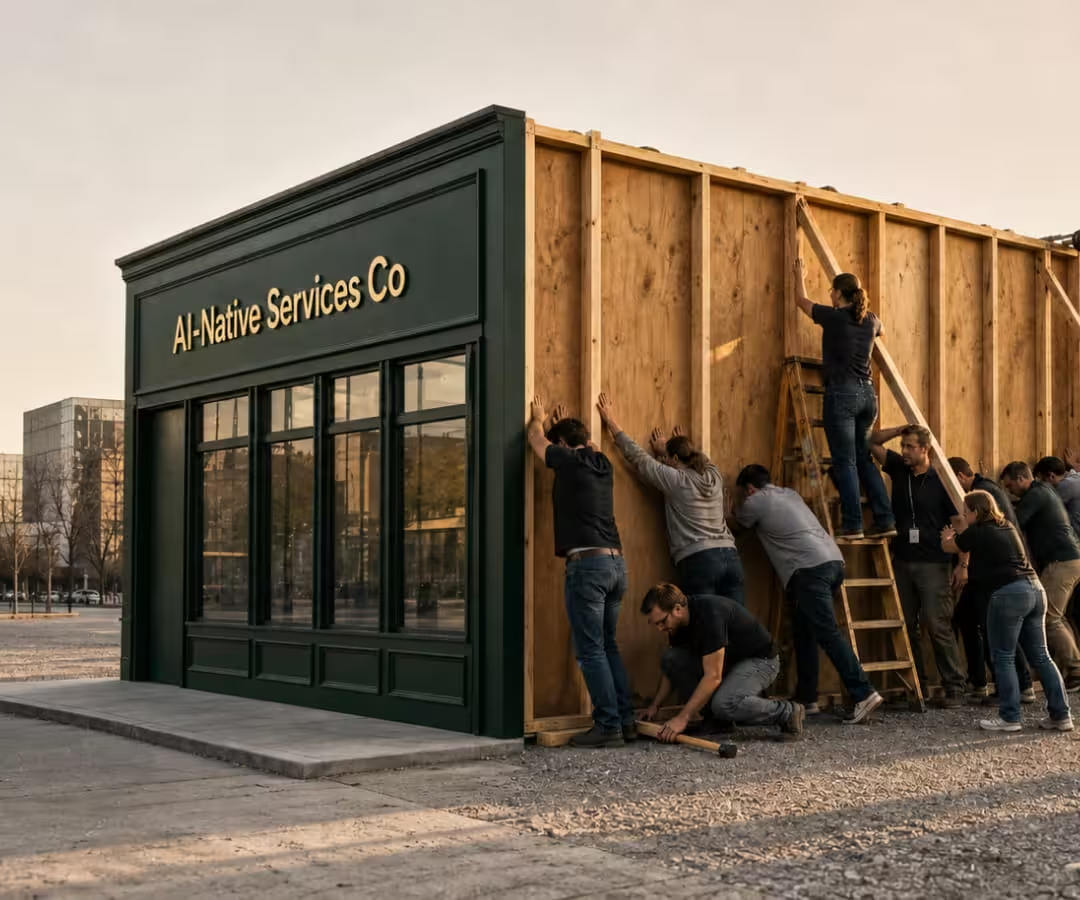
AI-native services companies face this challenge in a sharper form than software does. In SaaS, the org exists to build and sell a product. In AINS, the org is the product. Every hire, every workflow, every handoff either strengthens the data flywheel or breaks it. A coordination failure in an AINS company doesn't just slow a sprint. It shows up in the outcome you promised the customer. We go deeper on this in our AI-native services playbook.
We don't have a clean case study yet. What we do have is twenty years of spotting patterns early and building conviction in them before they're obvious. The pattern is clear enough to act on.
The deeper shift isn't that AI makes individuals more productive. It's that the company itself becomes a system that coordinates that productivity.
The leverage shift is real
An exceptional operator finds a 5x improvement in their workflow, then loses most of that gain to ambiguous priorities, missing context, slow decisions, or feedback loops that take days instead of minutes. The data backs this up: across every company size, AI companies currently generate less revenue per employee than their non-AI peers. The tools are working. The organizations built to direct them mostly aren't there yet. The leverage is in the tool. The output is in the environment. This is why AI-native companies should optimize the company itself as a system, one that can actually absorb and direct the output AI is making possible.
Harper, an AI-native insurance brokerage, is the clearest version of this we've seen. The team doesn't sell a tool to brokers; they own the underwriting and placement workflow end to end. Roughly 11 engineers built the entire company. (For reference, the average Series B company today runs a team of 48.) What makes their trajectory remarkable is that the same small team stood up several startups' worth of systems inside one company: an AI-native CRM, support, a transactional platform, voice/call-center agents, a 2,000-carrier matching engine, and long-range coding agents.
The unlock was the environment: one integrated operating system, shared context and data by default, humans concentrated on the ~10% of the work that actually needs judgment, and tight feedback loops, with in-house labelers feeding validation back into every agent. That's what "leverage in the tool, output in the environment" looks like when a company is actually built around it.
What AI-native companies actually look like
Across the AINS teams we work with on hiring and org design, the same patterns show up in whoever's moving fastest.
Direction needs to be explicit and accessible. Strategy can't live in a founder's head or a quarterly all-hands. It needs to exist in artifacts anyone, or any agent, can act on: written specs, structured goals, decision logs. If an AI can't act on it, neither can an employee.
Work should break into small units rather than big handoffs. Tasks scoped small enough to be picked up by an agent or a human in a single sitting, with clear acceptance criteria. As work splits into smaller units, overall throughput multiplies.
Context needs to be shared by default. Customer feedback, code changes, decisions, ongoing projects, all of it accessible without asking. The teams that move fastest treat context infrastructure as core company infrastructure, not a side project.
And feedback loops need to be short and measured. Quality checks, evals, learning mechanisms that close the loop on what's working. The goal is a company that behaves like a self-improving system: one that senses, decides, acts, measures, and adjusts.
The org chart changes shape
As work distribution gets faster and context gets cheaper, the role of management evolves. This shows up in how AI-native companies are already staffing differently: they put 11 percentage points more of their headcount into engineering than the broader tech market, and structurally less into sales, support, and finance. The lower leverage parts, translating, routing, status gathering, relaying context, get absorbed by this new infrastructure. The higher leverage parts, judgment, coaching, prioritization, designing the system itself, become the job. Managers don't disappear in AI-native companies. Their leverage shifts up the stack.
%20(1).jpg)
Hanover Park shows the same instinct applied to structure. Chris Hladczuk, CEO, described moving to engineers owning outcome metrics and acting as product-plus-engineering in a pod system organized by functional area. It’s a way to scale engineering without bloat. The structure is still proving out, but it's a clean illustration of designing the environment rather than bolting AI onto an old chart.
The talent profile is shifting. The most valuable hires are the people who improve the system around them and raise the output of everyone else. Operators who can both produce and design: people who ship, and who think hard about the system they're shipping inside of. For founders, that's the hire profile to optimize for, and it's a different bar than "great at the work."
A few things worth being deliberate about:
- Treat the company as a system: write down the loops, track them, know which ones are tightening and which aren't.
- Invest in coordination infrastructure as early as product infrastructure: shared context, memory, and alignment protocols are not back office concerns, they're how throughput scales.
- Hire for judgment and ownership, not headcount targets: each hire should raise the ceiling, not just the floor.
- And make everything searchable from day one. If an agent can't access your strategy, customer signal, and operational state, your team probably can't either.
The companies that get this right will have teams that feel impossibly small for what they're producing, because the environment is doing the heavy lifting.
For the last twenty years, founders scaled companies by adding people. Over the next twenty, leading founders will scale companies by designing systems that compound judgment.
Asking a startup how many employees it has will soon sound as outdated as asking how many servers it owns. Let’s ask, instead, how effectively its operating system turns judgment into action.