Mirage PMF is the failure mode we're seeing most often in AINS companies right now: fast revenue growth, strong customer retention, but the majority of the service is still being delivered by humans, not AI.
It happens the same way every time. You go to market, you're faster, better, or cheaper than the incumbent, and buyers say yes. Revenue inflects. You hire delivery staff to meet demand. Each hire feels like the right call. The revenue keeps growing. The AI platform keeps waiting.
Every time you hire another human to deliver the service instead of investing in the AI platform, you're compounding the mirage. Your revenue looks like a software company. Your gross margins look like a staffing firm.
You haven't built an AI-native services business. You've built a services business with the wrong kind of funding.
Why it happens
Most founders who end up here didn't make a single bad decision. They made a hundred reasonable ones.
The core tension in an AINS business is unique: you are simultaneously a professional services company, bound to your clients' urgent needs, and a technology company that must invest in building the AI platform that will eventually make those urgent needs tractable. These two imperatives are in direct conflict, and the professional services side wins almost every time because clients are paying you and demanding things now.
The result is a relentless pull toward the urgent over the important: you are always responding, never building. Your revenue curve looks great. Your AI leverage curve is flat.
Venture capital compounds this. Investors celebrate the revenue, but that’s not the full picture.
How to diagnose the mirage
Ask yourself one question: can you tell me, right now, how much AI leverage you're getting on each granular component of your service, in both speed and quality?
Not at the macro level. Not "we're automating 40% of the workflow." At the task level. The specific steps. The individual handoffs.
If you can't answer that, you’re in danger of Mirage PMF.
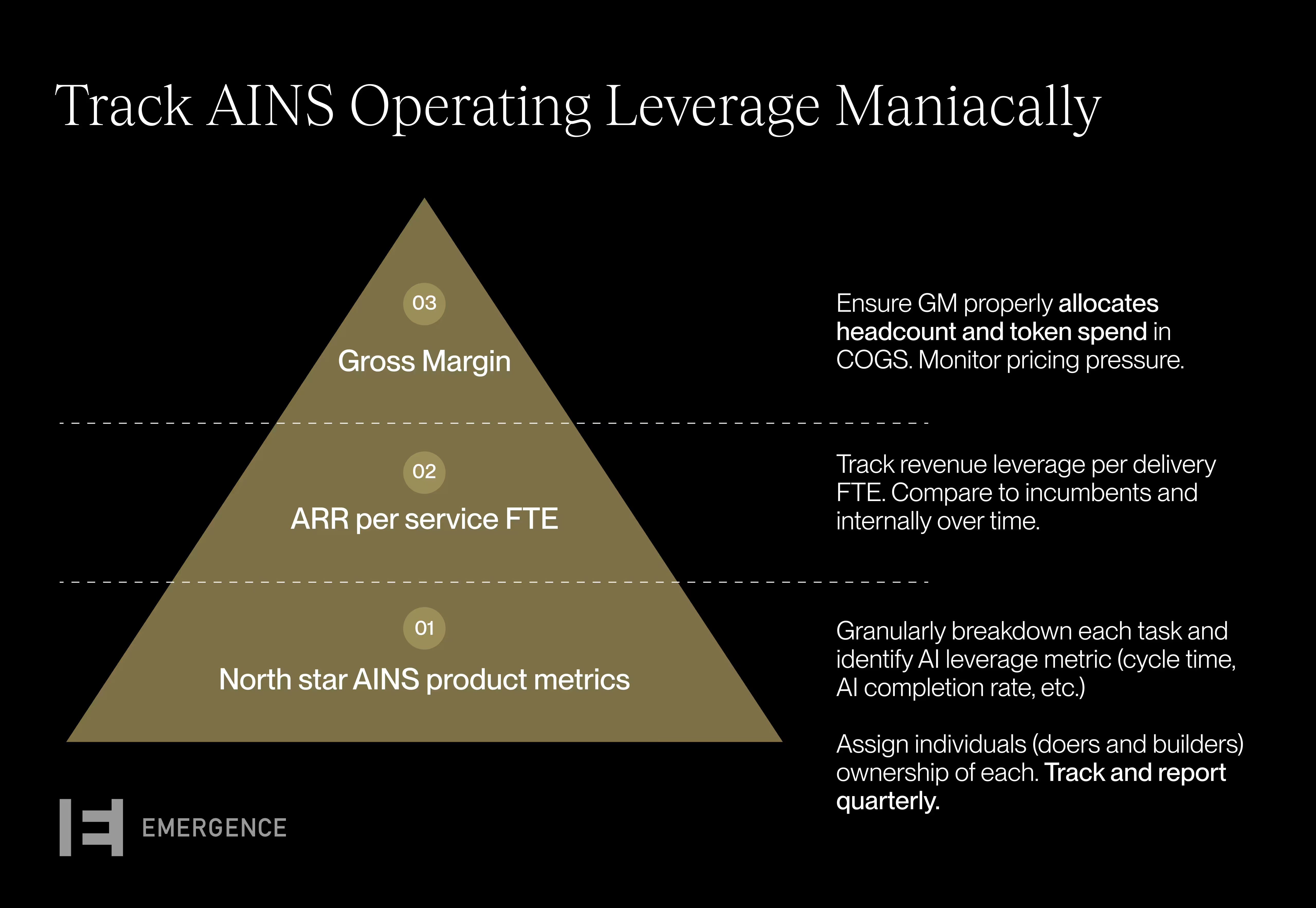
The North Star metrics for AINS companies look fundamentally different from SaaS. In SaaS, product usage was a reasonable proxy for value. In AINS, your customers ideally never touch your product. Your employees do. Usage is irrelevant. What you need instead:
North Star AINS Product Metrics. These are specific to your company. Map every step of your service delivery. For each step, track how much AI can complete at your quality bar. Time to finish the task. How much human review is needed.
Then assign each metric to a person or a duo. Some AINS businesses assign a doer/builder pairing to drive a specific metric.
Track and report these at the board level quarterly. If nobody owns a metric, it won't move.
ARR per service FTE. How much revenue is each service-delivering human generating, relative to your industry baseline?
If you're not at least 2.5x better, your AI isn't creating real leverage yet.
Then watch the trend. This number should climb every quarter. Flat means your growth is coming from hiring, not from AI.
Gross margin, calculated honestly. The lagging indicator. Above 70% and you'll command software multiples. Between 50 and 70% and you're better than legacy services but priced like one. Below 50% and you're a services business with a venture cap table.
One catch: calculate it honestly. Include the salaries of everyone doing delivery work AND the inference spend that goes towards delivery. I've seen too many companies exclude one or the other.
The first metric is the leading indicator. The third is the outcome. Most founders only watch the third, which means they find out they have a problem 12 months too late.
What it takes to get it right
The best AINS founders we've worked with have had to make a counterintuitive decision: deliberately stop growing to build the AI.
One AINS company in our portfolio has made this its operating rhythm. Every other quarter, the CEO stops selling entirely. The team further builds out the AI platform, trains new human operators to sit on top of it, deploys them, then reopens sales. The revenue curve looks like a staircase, not a ramp. It's uncomfortable. But they've maintained gross margins in the low 70s while scaling quickly. That's the difference between a business and a mirage.
The yellow line in the chart below depicts a path from mirage PMF to true PMF.
.png)
The stakes
When you go to raise your Series B or C, a good investor will ask for recurring revenue per service FTE. They'll double-click on your gross margins. They'll want to know how your AI leverage metrics have moved. If you've been measuring the wrong things, you'll find yourself unable to answer questions that should have been answered two years earlier. The numbers will reveal what you've actually built: a professional services firm with a venture cap table.
The competitive risk is just as real. The AINS companies that crack AI leverage early will have dramatically better margins, which means they can undercut you on price, invest more aggressively in the platform, and build a compounding advantage. First mover advantage in AINS may matter less than early leverage advantage.
What to do
If you're early and revenue is growing, don't wait to build the diagnostic infrastructure. Define your North Star metrics at the task level now, while you still have the bandwidth. Assign ownership. Make them visible internally.
If your service headcount is scaling alongside your revenue, be honest about what that means. It's not too late to fix it, but it requires the hardest decision in AINS: slowing the top of the funnel to build the thing that makes the business actually work.
The goal isn't to grow as fast as possible. It's to build an enduring, high-margin services business. In AI-native services, those often require opposite actions.