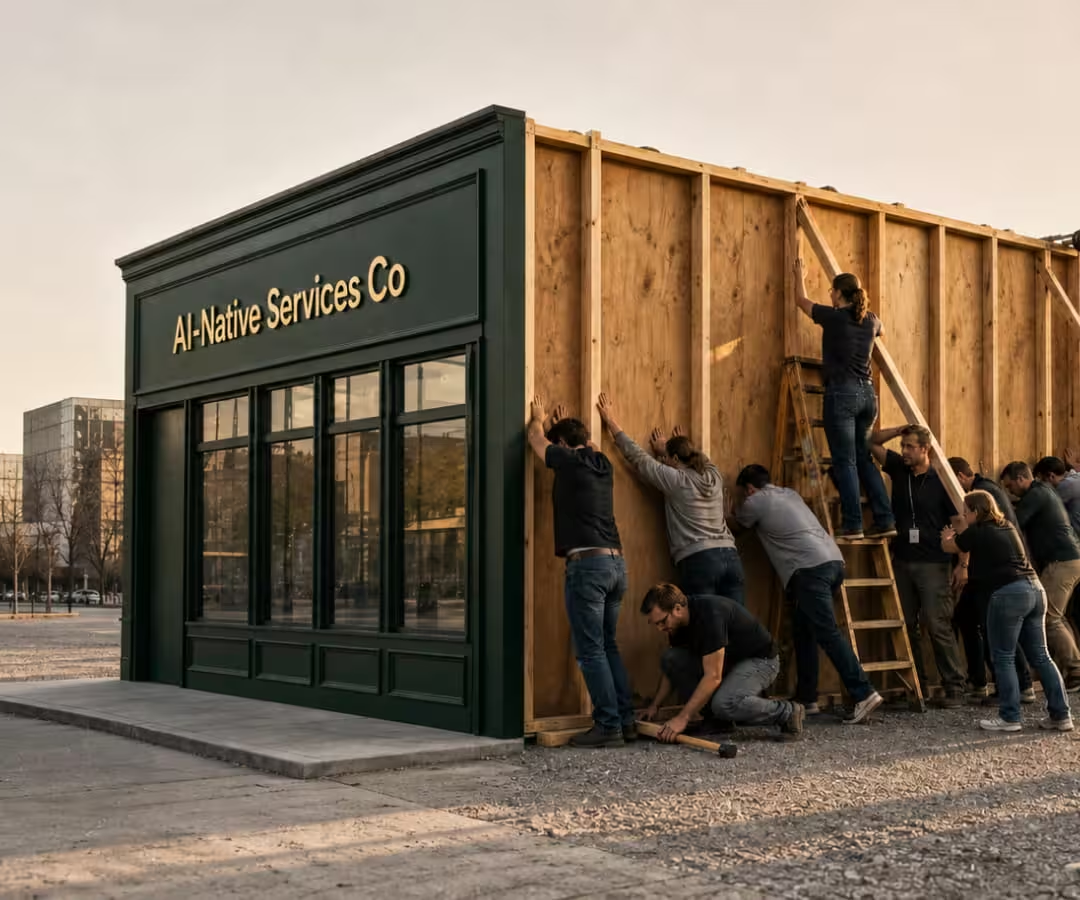
Innovation in the digital world has compounded for decades. Software gets faster. AI systems improve at an exponential pace. Yet our physical infrastructure tells a different story. Bridges age, housing supply lags demand, and we struggle to build factories, data centers, and public works at the pace the economy requires.
One reason is structural: we're limited by what can be built safely within a given period of time, and by severe labor shortages in the trades required to build it.
The combination of high safety requirements and persistent labor scarcity is where autonomy shines.
Waymo proved this on our roads. Now the same shift is reaching construction. And Bedrock Robotics is leading the way.
Today, Bedrock announced a $270M financing to build Waymo for construction. Emergence is thrilled to partner with the Bedrock team on this quest.
The Moment That Made It Click
As we were getting to know Bedrock’s founders, Boris Sofman and Kevin Peterson, something unexpected happened on a job site.
An autonomous excavator had been trained to scoop dirt into dump trucks. At one point, no empty truck arrived. The team wanted to see what the system would do.
Instead of idling, the excavator began rearranging the dirt, organizing it in a way that would make loading faster once the next truck showed up.
This wasn't programmed. It wasn't trained. The system taught itself.
That's when the scale of what Bedrock is building became clear. This isn't remote control with extra steps. It's machines that reason about work.
A Structural Problem Meets a Structural Solution
The U.S. construction industry is short roughly 349,000 workers today and expects to be short 450,000 next year. That gap isn't cyclical. It's structural. And it's already slowing what gets built: housing starts delayed, infrastructure projects stalled, data center timelines stretched.
Meanwhile, construction productivity has barely improved in decades. Projects remain constrained by human availability, fixed shifts, and equipment that has evolved far more slowly than the environments it operates in.
You can't close that gap with incremental software. You need a new operating model.
Why Construction, Why Now
Autonomy is often framed through robotaxis. But heavy construction has a different, and in many ways more favorable, set of conditions:
- Structured environments with clear boundaries
- Repeatable tasks with measurable outputs
- Slower-moving machines in constrained workspaces
- Immediate, demonstrable ROI
Bedrock's founding team, including leaders from Waymo, understood this deeply. They applied lessons from operating autonomy on public roads to machines that are larger, slower, and already central to how the physical world gets built.
In many ways, automating an excavator is easier than automating a car navigating city streets. And the payoff is more immediate.
Across Bedrock's early deployments, value is appearing where contractors care most:
- Faster projects: higher utilization, extended operating hours, fewer delays
- Safer projects: reduced operator fatigue, fewer incidents, better site awareness
- More predictable projects: tighter timelines, consistent output, better planning
Bedrock is also engaging the broader industry. By positioning a neutral autonomy layer that can work across existing fleets like Caterpillar’s machines, they are building toward deployment at scale. This is how new technology creates new operating models. Autonomy here is not a standalone product. It becomes part of how work gets done day to day on a job site. And when autonomy delivers across throughput, safety, and schedule certainty simultaneously, it stops being experimental. It becomes essential.
Autonomy as an AI-Enabled Service
At Emergence, we see Bedrock through a lens that shapes how we invest: AI-enabled services.
Bedrock isn't selling software. It's selling outcomes: yards moved, projects completed faster, timelines made predictable. The autonomy is inseparable from the service it enables.
That creates enormous value on the job site. It also creates meaningful questions around value capture.
From the beginning, we've worked closely with the Bedrock team on pricing and packaging, drawing on our experience helping AI-enabled companies price against delivered outcomes rather than underlying technology. As autonomy improves throughput, safety, and predictability at once, the opportunity is to capture it in a way that aligns incentives and scales with deployment.
This is where autonomy stops being a feature and becomes a business model.
What Becomes Possible
The long-term impact isn't just faster excavation. It's what happens when machines operate longer, more consistently, and in tighter coordination with human teams.
That changes how projects are staffed. How timelines are planned. How productivity is measured. And ultimately, what gets built at all.
We believe Bedrock has the potential to become the default autonomy platform for heavy construction, reshaping how physical work gets delivered. You’ll see cities that are built by humans and robots, directed in a coordinated ballet by Bedrock.
Congratulations to Boris, Kevin, Laurent and the entire Bedrock team. The built world is about to move faster.