For sixty years we could only read the code of life. A small team has now taught AI to write it — and that changes which company will own the next era of medicine.
In 2024, a pair of molecular scissors cut a strand of DNA with precision. This working, synthetic CRISPR system was designed by Evo, an AI trained on the raw code of life. The model also authored the target DNA itself.
I have spent my career around software that lives and dies on a screen. This was something else. A digital model had reached into the physical world and made biology do what it was told. Biology has spent its entire history as a thing we read. Evo was the start of something different: the moment it became a thing we can write.
Over sixty years, we learned to sequence the genome and to trace a disease back to a single misplaced letter. Eventually, we learned to edit; to reach in and correct one typo at a time. What we could never do was author: write new, functional biology from a blank page. That is the line Evo crossed. Its creators call the new field generative genomics, and it raised the question that will define the next decade of medicine. Who will be trusted to build the foundational infrastructure for an era of written biology?
I found my answer at a dinner at Il Fornaio in Burlingame on February 23rd, alongside my colleague Kyle Murphy.
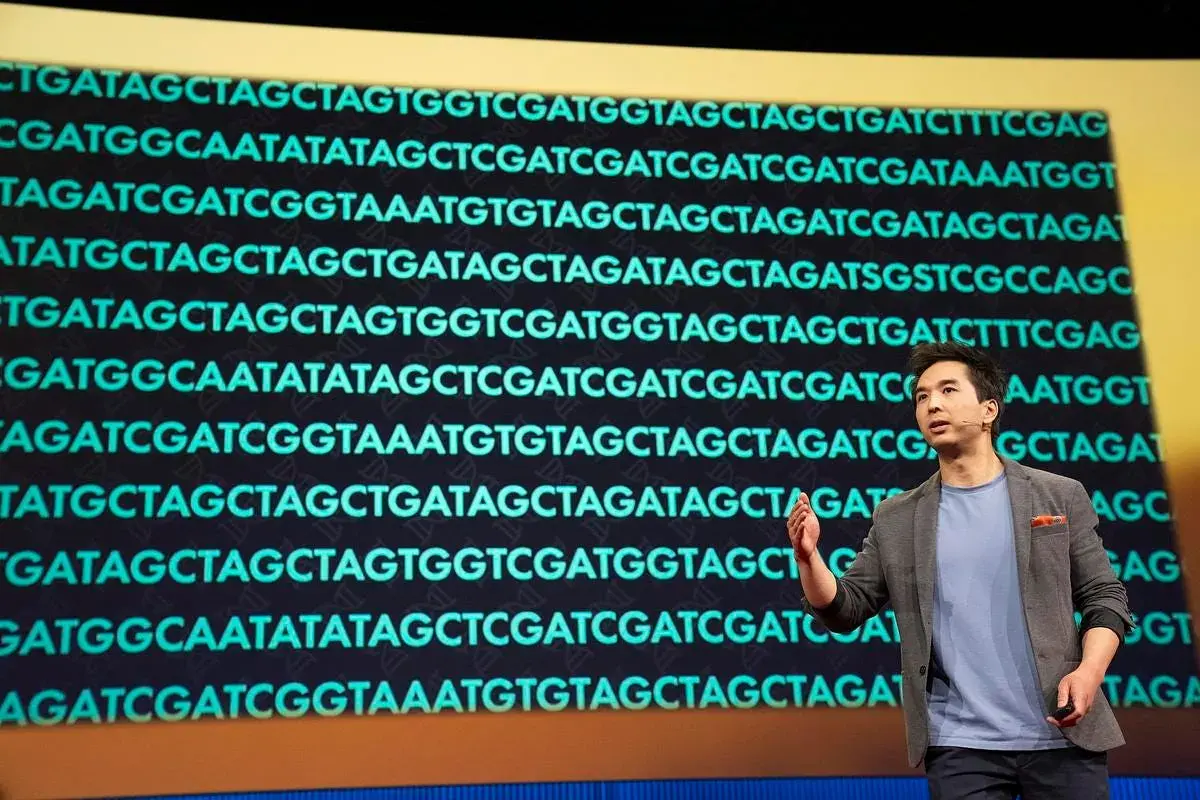
As an investor — and a former entrepreneur myself — you grow numb to a certain kind of founder: the one who performs, who arrives over-rehearsed with a story scaled to the size of the round. Eric Nguyen is the opposite. Calm, precise, focused on the problem rather than impressing anyone at the table. Driven by questions and the signals from their answers. He reminded me of the early conversations I watched Dario Amodei have while building Anthropic, and of the instinct underneath them: that the more powerful the thing you are building, the more seriously you take the risk of building it.
Eric and his co-founders at Radical Numerics are the team behind Evo and Evo 2, the models that turned that question from a thought experiment into a result on a lab bench.
What they are building now is broader than any one model. Most AI in biology is narrow — one system predicts how a protein folds, another reads a stretch of DNA. Radical Numerics is building a single model that learns across DNA, RNA, proteins, and more simultaneously, the way they actually work together inside a living cell. The team calls it general biological intelligence, and the breadth is the point. It reaches problems — diagnosing rare cancers, defending against engineered pathogens — that no single-purpose model can touch.
My conviction comes from experience.
In 2008, I sat across from Peter Gassner, who was then running a 25-person company with less than a million dollars in revenue. The same quiet conviction. The same questioning. The same sense of a small team that understood an entire industry more deeply than the incumbents who had run it for decades. We invested in Veeva, and we stayed. Today, it is worth tens of billions; its software runs inside most of the global life sciences industry. In 2021, it became the first publicly traded company to convert to a Public Benefit Corporation, because the best companies tie their commercial success to something larger than themselves.
Spending fifteen years close to the world's leading life sciences companies teaches you to recognize a shape when it forms again. I see it here: another team building with the intention to serve more than its own balance sheet.
That is why Emergence is leading Radical Numerics' $50 million seed round, alongside Obvious Ventures, Triatomic Capital, First Spark Ventures, and Factory.
The field is already building on their work. Evo is now the largest open-source biological AI project to date, and other researchers have used it to generate a synthetic bacteriophage: a virus that infects bacteria but leaves people unharmed.
It is worth being concrete about where this points. Consider the recent work silencing the PCSK9 gene: a single base-editing change to how the liver handles cholesterol, a potential one-time alternative to lifelong statins. Radical Numerics did not produce that result. But it is exactly the kind of outcome that becomes reachable and repeatable once you can design biology instead of merely reading it. Rare cancers caught earlier. Treatments shaped around a single person's genetics. Durable cures for diseases we can only manage today.
There is one thing to be clear-eyed about. Teaching AI to write biology poses real risk: the same capability that designs a cure can also design a threat. Most companies would treat that as a disclaimer to manage. Radical Numerics treats it as architecture. The co-founders run the company under a dual mandate: advance biological design to transform human health, and build biodefenses to protect it so its defenses scale at exactly the same rate as its discoveries. That second commitment is not a footnote. It is the reason a technology this powerful deserves to exist.
Biology has spent its whole history as read-only. The read-write era starts now, and we are glad to be building it with Eric and his co-founders.


.avif)